From Components to Copilots: Front-End Development Enters Its AI-Native Era
标签:Frontend|AI|React
封面:
Abstract
Front-end development remains the most widely practiced and most human-facing discipline in software. In 2026 it is being rebuilt around AI: 42% of committed code is already AI-generated or AI-assisted, GitHub Copilot serves 77,000+ organizations, and specialized coding models are cutting front-end error rates dramatically. The interface layer is becoming the innovation layer.
Table of Contents
-
I. A Foundation That Refuses to Move
-
II. Low-Code and the Industrialization of the Interface
-
III. Vibe Coding Goes Mainstream
-
IV. Specialized Agents Enter the Pipeline
-
V. Economics and Guardrails
-
VI. Conclusion: The Interface Layer Becomes the Innovation Layer
I. A Foundation That Refuses to Move
For all the talk of disruption, the front-end stack has never been more stable at its core. The 2025 Stack Overflow Developer Survey, drawn from more than 49,000 developers in 177 countries, confirms that the web trilogy still dominates professional work: JavaScript was used by 68.8% of professional developers in the past year, HTML/CSS by 63%, and TypeScript has climbed to 48.8% among professionals (43.6% across all respondents)。 Industry analysis now describes TypeScript as “the default, not an upgrade,” with major toolchains including Vite, Vue and Next.js shipping TypeScript-first starters, and the State of JavaScript 2025 survey reporting that 40% of respondents now write only TypeScript.
The framework conversation has matured rather than fractured. Trend analysis for 2026 converges on three shifts that separate well-architected products from struggling ones: React Server Components, signals-based fine-grained reactivity, and Interaction to Next Paint (INP) as the performance metric that actually reflects user-perceived responsiveness. WebAssembly, long treated as an experiment, has crossed into production viability. And because React plus TypeScript plus JSX constitutes the largest share of AI training data for code, the React and Next.js ecosystem has become the default target for AI-integrated application development, reinforced by the wide adoption of the Vercel AI SDK.
This maturity is visible in enterprise engineering practice, not only in surveys. Yunnan Nantian Information, a listed Chinese financial-IT company, disclosed in its 2023 annual report that its completed enterprise data management R&D project uses a B/S architecture whose front end is built with HTML5 + CSS3 on the Vue framework, providing a unified asset-center portal accessible from any browser without dedicated client software. Even at the industrial frontier, the “boring” fundamentals — component models, declarative rendering, browser-first delivery — are precisely what make front-end systems maintainable at scale.
II. Low-Code and the Industrialization of the Interface
The second structural trend is the industrialization of interface production through low-code platforms. Beijing Shenzhou Aerospace Software Technology, in its 2023 semi-annual report, described its low-code rapid development technology as enabling developers to produce software quickly “without caring about underlying architecture design,” building business processes, logic models and data models through intuitive visual interfaces and graphical controls instead of traditional hand-coding, across both single-application and mobile development modes.
Nantian Information’s completed financial application development low-code platform (with RMB 2.02 million in capitalized R&D) follows the same playbook: microservice and cloud-native architecture, graphical orchestration, a managed component library, and a multi-language runtime. For front-end teams, low-code is less a replacement than a redistribution of labor — the repetitive 80% of CRUD screens gets assembled, while engineering attention concentrates on design systems, interaction quality and the integration points where hand-written code still wins.
III. Vibe Coding Goes Mainstream
The headline change of 2026 is that AI has moved from autocomplete to co-author. Belitsoft’s 2026 React Landscape Report estimates that 42% of all committed code is now AI-generated or AI-assisted, a figure projected to climb to 65% by 2027.
【图表:AI-Generated or AI-Assisted Share of Committed Code】
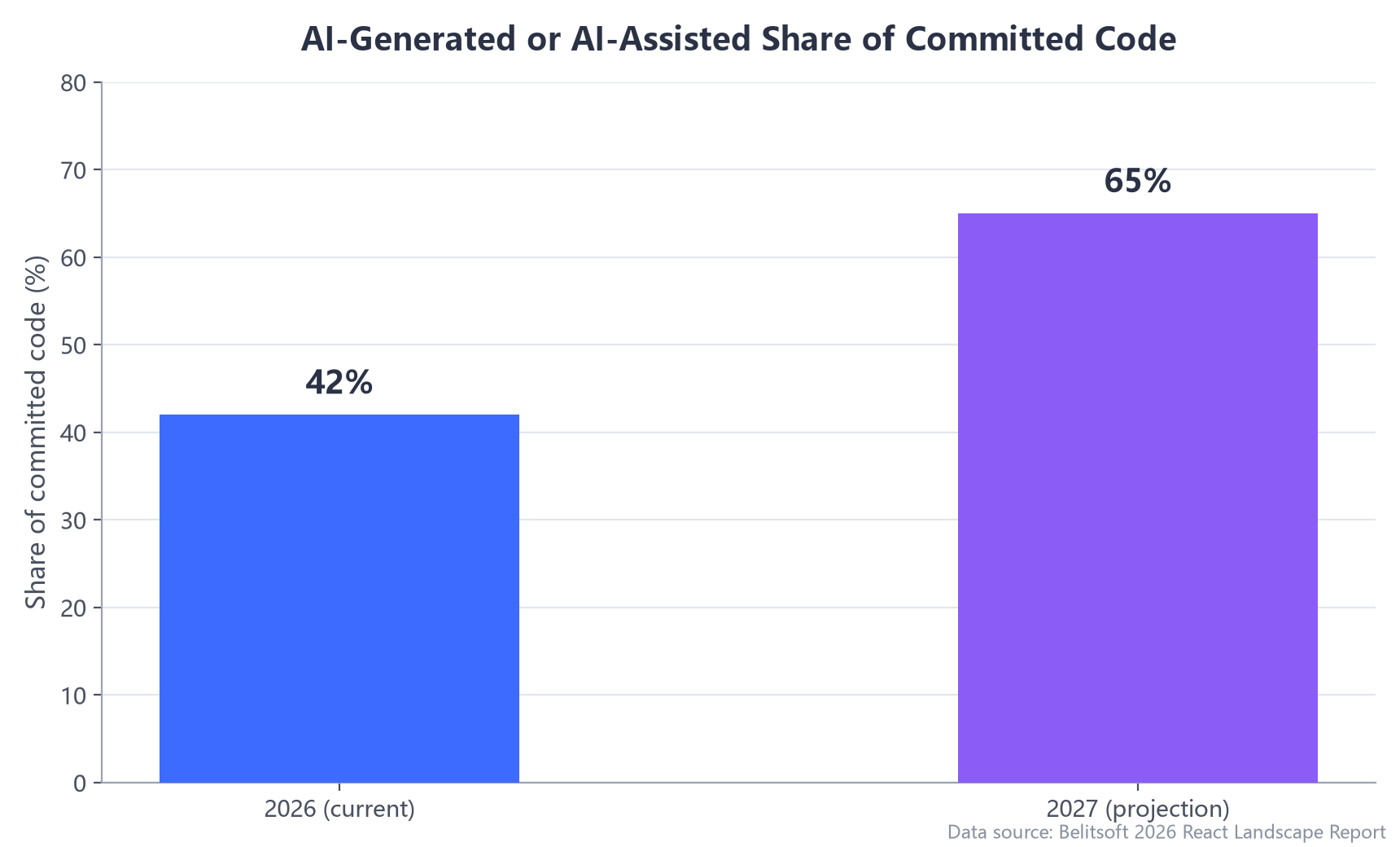
As the chart shows, within roughly two years nearly two-thirds of the code entering repositories — and front-end code, being the most templated and training-data-rich category, leads this curve — is expected to originate with AI assistance.
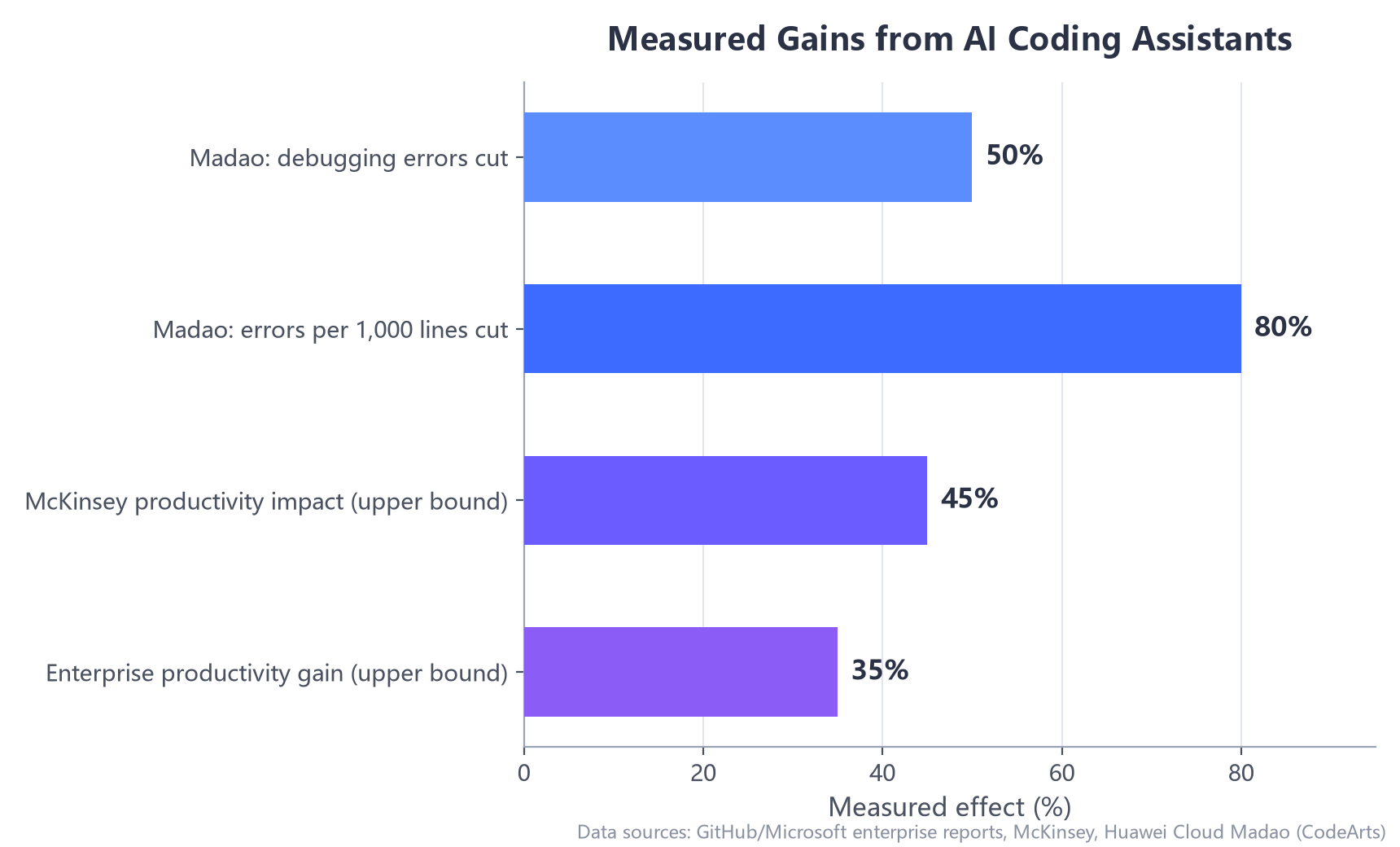
The commercial engine behind this shift is visible in GitHub Copilot’s numbers, as reported in international media coverage of AI coding’s rise: the assistant, broadly launched in 2022, has reached nearly 2 million paid users; more than 77,000 organizations — from BBVA and FedEx to H&M and Infosys — have adopted it, a 180% year-over-year increase; and Copilot contributed over 40% of GitHub’s revenue growth, according to Microsoft CEO Satya Nadella. Enterprise customers generally report productivity improvements of 20% to 35%, while McKinsey analysis found that generative AI’s direct impact on software engineering productivity could reach 20% to 45% of current annual spend. Capital has followed: AI coding attracted nearly US$1 billion in funding as it earned “killer application” status.
The frontier has now moved to full-stack generation from multimodal input. ByteDance’s Doubao 2.1 Pro, upgraded in September 2026, explicitly strengthened front-end development and design-restoration capabilities: fed a screen recording plus a few sketches, it can build mobile pages for legacy ERP systems without documentation, and it converts design mockups directly into runnable code — with vision-language models also enabling autonomous repair of game UI defects. Moonshot AI’s Kimi K3, a 2.8-trillion-parameter open model, demonstrates “full-stack web generation”: from a single sentence, a design image or a phone screenshot, it assembles front-end and back-end code into a working public website within tens of seconds. As the Kunpeng DevKit AI team observed at Huawei Connect 2026, the industry is shifting from “manually reading documents and invoking tools” to “describing intent in natural language while agents orchestrate execution” — the essence of the vibe-coding era.
IV. Specialized Agents Enter the Pipeline
General-purpose models, however, hit a wall in domain-specific code. The Kunpeng DevKit AI team is blunt about the failure modes: general models lack deep training on specific architectures, hallucinate plausible-but-wrong best practices, miss expert knowledge scattered across tools and documents, and waste tokens blindly scanning entire codebases. The response across the industry is a new layer of specialized coding agents.
Huawei Cloud’s Madao (CodeArts) HarmonyOS coding model illustrates what specialization buys. Trained on more than 1 million HarmonyOS source materials with 100% coverage of high-frequency components, it reduces errors per 1,000 lines of code by more than 80%, and its HarmonyOS-specific agent cuts code debugging errors by more than 50%. Its built-in DevEco CLI can drive the on-device simulator directly, compressing the generate-verify feedback loop from hours to minutes — for UI-intensive mobile front-end work, arguably as valuable as generation quality itself.
【图表:Measured Gains from AI Coding Assistants】
The agent layer is also being productized for front-end work specifically. aiXcoder 7.0 ships a “front-end development agent” alongside back-end and testing agents, with an agent factory allowing enterprises to assemble project-specific and framework-specific agents on demand. The emerging architecture of front-end tooling is therefore two-tier: general copilots for breadth, specialized agents for the domains where correctness is non-negotiable.
V. Economics and Guardrails
The economics are compelling but not unconditional. The 20%-to-35% productivity gains reported by enterprises come with a standing caveat from GitHub itself: AI-generated code should not reach production without human review, and large enterprises’ IT departments retain reservations about security and provenance. Hallucination remains a structural property of probabilistic models — the same Kunpeng analysis that celebrates agents also documents their failure modes — which is why traceable build pipelines, component-level testing and design-system constraints matter more, not less, in an AI-native workflow.
The skills ledger is shifting in parallel. McKinsey’s conclusion that generative AI “may push the skills and capabilities required for software engineering toward code and architecture design” lands with particular force on the front end: when screens can be generated from sketches in seconds, competitive advantage migrates to system design, accessibility, performance budgets, and the judgment to review what the model produced. The developers who thrive will treat AI output as a first draft — never as a finished interface.
VI. Conclusion: The Interface Layer Becomes the Innovation Layer
Front-end development spent two decades industrializing the browser: components, frameworks, TypeScript, design systems. It will spend the next few years industrializing intelligence on top of that foundation — multimodal generation, specialized agents, minute-level feedback loops. The fundamentals documented in the Stack Overflow survey are not being displaced; they are being inherited by a new generation of tools that write in the same languages but at a different speed. For the discipline that owns everything users see and touch, the mandate of the AI-native era is clear: master the craft deeply enough to direct it, because the world’s interfaces are about to be written faster than ever — and someone still has to decide what they should say.